
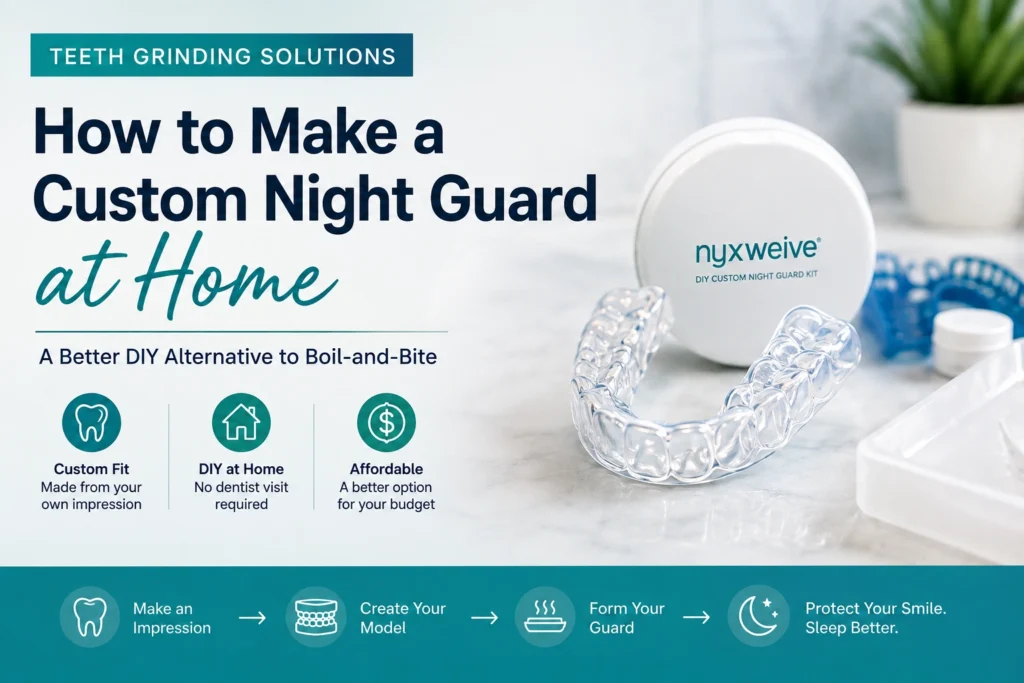
If you grind or clench your teeth at night, you’ve probably discovered an annoying gap in the market:
A custom night guard from a dentist can be expensive, while inexpensive store-bought guards are usually boil-and-bite.
So a reasonable question is:
Can you actually make a custom night guard at home?
Yes — but there is an important distinction between a simple boil-and-bite mouth guard and a true impression-based, custom-formed night guard.
Here’s what to know before you try one.
First: What Does “Custom” Actually Mean?
Not every night guard that is heated and molded at home is truly custom.
A typical boil-and-bite night guard starts with a pre-formed piece of thermoplastic material. You heat it, place it over your teeth, and bite into it to create a semi-custom shape.
It’s inexpensive and convenient.
But there is another approach:
Create an impression of your teeth first, create a model from that impression, and then form the night guard over the model.
This approach allows the guard to be shaped around the actual geometry of your teeth rather than trying to mold a generic piece of material directly inside your mouth.
That’s the basic idea behind a custom night guard made at home.
How Does an At-Home Custom Night Guard Work?
The exact process depends on the kit, but an impression-based DIY system generally follows these steps:
1. Make an impression of your teeth
Instead of molding the final guard directly in your mouth, you first create an impression of your teeth.
This captures the shape and position of your teeth.
2. Create a dental model
The impression is used to create a physical model of your teeth.
This gives you something you can use to form the guard around.
3. Form the night guard over the model
A thermoforming sheet is heated and formed over the model.
With a vacuum-forming process, the heated material is pulled closely around the model to reproduce its shape.
4. Trim and finish the guard
Once the material cools, the formed guard is removed from the model and trimmed for a comfortable fit.
5. Try your finished night guard
The result is a guard made around your own dental model rather than a generic mouthpiece.
DIY Custom Night Guard vs. Boil-and-Bite
This is where the two approaches are often confused.
| Boil-and-Bite | Impression-Based DIY | |
|---|---|---|
| Starting point | Pre-formed mouth guard | Impression of your teeth |
| Where molding happens | Directly in your mouth | Around a model of your teeth |
| Customization | Semi-custom | More individualized |
| Equipment | Usually just hot water | Impression + model + forming equipment |
| Cost | Usually low | Higher than basic OTC guards |
| DIY | Yes | Yes |
| Main advantage | Simple and inexpensive | Greater control over the final shape |
Neither approach is automatically right for everyone.
A boil-and-bite guard can make sense if you simply want an inexpensive, readily available option.
But if fit and customization are your priorities, an impression-based approach is worth understanding.
Why Not Just Buy a Custom Night Guard From a Dentist?
A dentist-made night guard can be an excellent option, particularly if you have significant dental problems, jaw problems, or other concerns that require professional evaluation.
The problem for many people is simply the price.
Depending on where you live and what type of appliance you need, a professionally made night guard can cost several hundred dollars.
That’s why people frequently look for alternatives.
This has created a growing middle ground between:
$20 OTC mouth guard
and
$500+ professionally made night guard.
At-home custom systems are one attempt to fill that gap.
What About Online Custom Night Guards?
There’s also another popular option:
at-home impressions + professional lab fabrication.
Companies such as NewSmile, Remi and other online providers send you an impression kit, you make your impressions at home, and the company uses them to manufacture the final guard.
This can be a convenient alternative to visiting a dental office.
But there’s an important difference between that model and a true DIY system:
Online custom:
You make the impression → a lab makes your guard.
DIY custom:
You make the impression → you make the guard.
For some people, that’s the whole appeal.
You don’t have to mail your impression away, wait for a laboratory, or pay someone else to manufacture the appliance.
You do the work yourself.
So, Is a DIY Custom Night Guard Right for You?
It depends on what you’re looking for.
A DIY system may appeal to you if you:
- grind or clench your teeth at night
- want a more individualized fit than a basic OTC guard
- don’t want to spend hundreds of dollars
- enjoy making things yourself
- want to understand and control the fabrication process
- want to make more than one guard from the same kit
On the other hand, a DIY appliance isn’t a replacement for professional dental care.
If you have significant jaw pain, damaged teeth, unusual bite problems, orthodontic appliances, or other dental concerns, it’s a good idea to talk with a dental professional before using a night guard.
And if you’re unsure whether you actually need one, that’s another good reason to get professional advice.
What Is Nyxweive?
Nyxweive is designed around a simple idea:
What if you could make your own custom night guard at home instead of buying a generic boil-and-bite guard or paying hundreds of dollars for professional fabrication?
The Nyxweive system uses:
Dental impression → model → vacuum forming → finished night guard
rather than simply heating a pre-made mouthpiece and biting into it.
The kit is designed for people who want to make their own night guards at home using a household vacuum cleaner and oven.
You can learn more about the complete process here:
The Bottom Line
If you’re searching for an affordable night guard for teeth grinding, you have more options than just:
$20 boil-and-bite vs. $500+ dentist-made.
There is a growing middle ground.
You can have a night guard made from an at-home impression by an online laboratory.
Or, if you are comfortable doing the work yourself, you can make a custom-formed night guard at home.
The important thing is understanding the difference between these approaches — and choosing the one that fits your budget, expectations, and needs.
If you’re curious about making your own, Nyxweive was created specifically for that purpose.